Bulk Food Factory Cleaning Chemicals in Ranjangaon
How should a food factory in Ranjangaon assess its cleaning chemical needs?
Start with a cleaning map, not a product catalogue. For Bulk Food Factory Cleaning Chemicals in Ranjangaon, list every cleanable zone: production lines, conveyors, utensils, floors, drains, storage areas, wash stations and CIP systems. For each area, record the surface material, soil type, cleaning method and the consequence of inadequate cleaning.
- Identify the residue: fats and oils, proteins, starches, sugars, mineral scale and burnt-on deposits need different chemistry.
- Assess operating conditions: water hardness, available water temperature, foam tolerance, application method, contact time and cleaning frequency influence suitability and bulk consumption.
- Separate risk zones: food-contact surfaces and non-food-contact areas may need different sanitation controls, rinse procedures and supporting documentation.
For example, a Ranjangaon snack or dairy facility might require an alkaline degreaser for oily equipment residue, an acid descaler for hard-water scale in CIP circuits, and a floor cleaner or degreaser for greasy walkways. The right category depends on validated site procedures, not just the visible dirt.
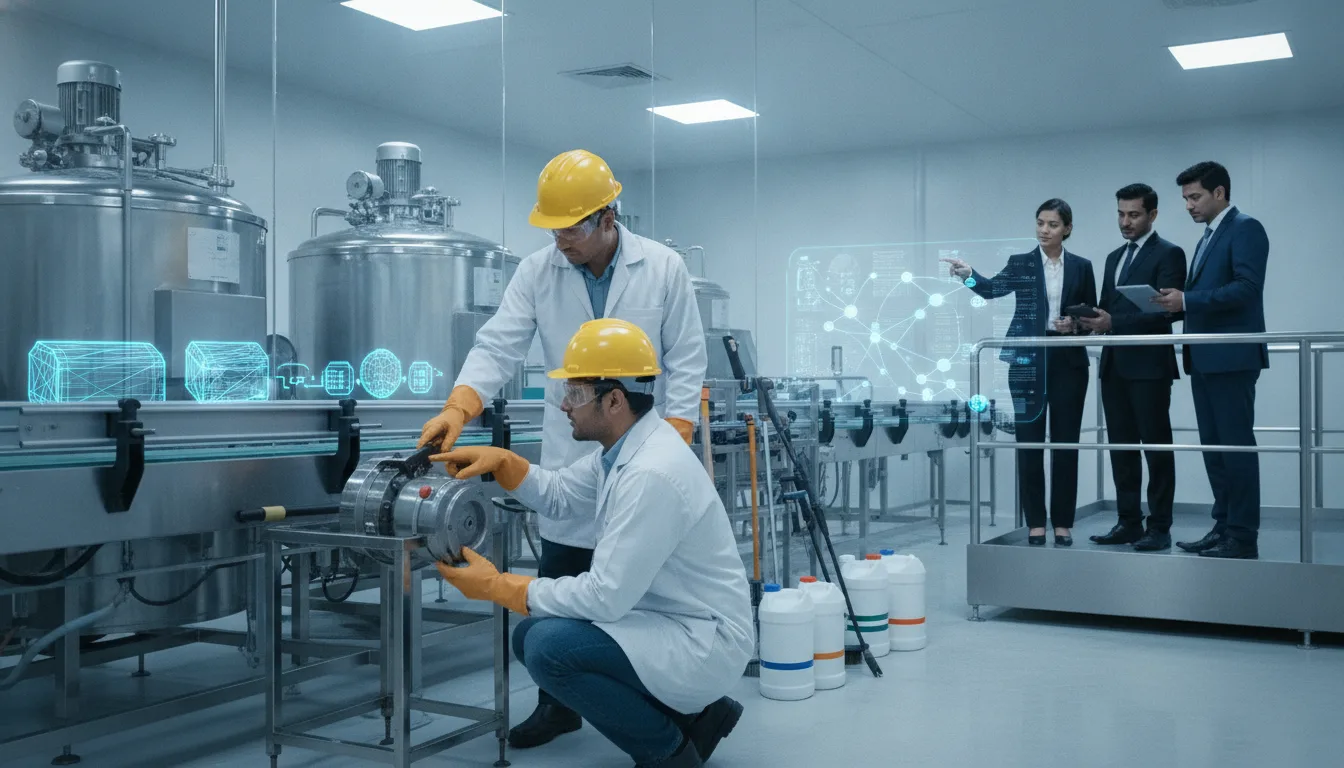
India's Food Safety and Standards Licensing and Registration Regulations, 2011, Schedule 4 requires hygienic processing conditions and cleaning arrangements. When reviewing food factory cleaning chemicals Ranjangaon, align product selection and delivery planning with your sanitation programme, safety data and usage instructions. To begin supplier evaluation, explore the company homepage.
Match chemical categories to the soil and cleaning task
For Bulk Food Factory Cleaning Chemicals in Ranjangaon, select chemistry by the soil, surface, water conditions and cleaning method, not by product name alone. Codex General Principles of Food Hygiene and chemical safety documentation both support using chemicals only as directed, with verified dilution, contact conditions and material compatibility.
| Illustrative task | Suitable category | Key check |
|---|---|---|
| Fryer-area grease | Alkaline cleaner | Verify surface compatibility and concentration |
| Protein deposits | Alkaline cleaner | Confirm rinse requirements |
| Dairy scale | Acid cleaner or descaler | Check corrosion risk and handling instructions |
| Routine floor soil | Neutral cleaner | Use where less aggressive chemistry is appropriate |
| CIP residue | CIP cleaning chemicals for food factories | Match the cycle to soil and equipment design |
Alkaline cleaners are commonly considered for fats and proteins, while acid cleaners address mineral deposits and water scale. Neutral cleaners can suit routine work where stronger chemistry is unnecessary. Always review the label, safety data sheet and equipment manufacturer guidance before use.
Cleaning removes soil, but it does not automatically sanitize or disinfect. Selection of food processing plant sanitation chemicals must follow the facility hygiene plan, approved use instructions and required post-cleaning steps. When comparing Ranjangaon industrial cleaning chemicals, explore the company homepage for currently available information.
What should buyers check before ordering bulk quantities?
Before ordering Bulk Food Factory Cleaning Chemicals in Ranjangaon, ask for documentation that supports safe, repeatable use. The UNECE Globally Harmonized System identifies safety data sheets and container labels as core hazard-communication tools.
- Safety data sheet, technical data sheet and dilution instructions.
- Storage conditions, shelf life, batch number and traceability details where applicable.
- Compatibility confirmation for stainless steel, aluminium, seals, hoses, flooring and dosing equipment.
- Packaging options for bulk industrial cleaning chemicals, including cans, drums or larger containers, plus drum-handling needs.
- Minimum order quantity, delivery lead time and enough segregated storage space for the stock.
Compare total-use cost, not just the price per drum. For example, Concentrate A costs ₹1,000 for 20 L and dilutes at 1:100, producing 2,000 L of prepared solution, or ₹0.50 per litre. Concentrate B costs ₹900 for 20 L at 1:50, producing 1,000 L, or ₹0.90 per litre. Calculate the cost per diluted litre or per cleaning cycle using your actual dosing rate.
For food factory cleaning chemicals Ranjangaon buyers, confirm delivery and evidence requirements before issuing a purchase order. To review currently available supplier information, explore the company homepage.
Food safety, worker safety and environmental controls to verify
For food factory cleaning chemicals in Ranjangaon, control does not end when bulk stock arrives. Written cleaning and sanitation procedures should specify the approved chemical, dilution, contact time, rinsing requirement and verification method for each task. This creates a repeatable record for hygiene teams and supports applicable food-hygiene expectations.
- Train operators on required personal protective equipment, safe dosing, chemical segregation and spill-response actions.
- Use the stated dilution. Over-concentration can increase chemical cost, residue concerns and handling risk, while under-concentration may compromise the intended cleaning process.
- Check chemical storage, wastewater discharge and disposal practices against applicable local, state and national pollution-control requirements.
A practical documented control can include labelled dosing stations, approved measuring equipment and supervisor verification records showing the chemical, batch, dilution and cleaning area. Government food hygiene, occupational-safety and pollution-control guidance should inform these site procedures.
Do not treat the term food grade cleaning chemicals as proof of food-contact approval. Request product-specific technical documents, safety data and relevant suitability information. Before evaluating a supplier, explore the company homepage for currently available information on Ranjangaon industrial cleaning chemicals.
How to evaluate a cleaning chemical supplier for a Ranjangaon facility
When evaluating suppliers of Bulk Food Factory Cleaning Chemicals in Ranjangaon, ask for current safety data sheets, technical data sheets, usage and dilution instructions, and packaging specifications. Confirm there is a clear channel for technical questions, especially where cleaning procedures, water quality, equipment materials, or soil loads vary.
When comparing Ranjangaon industrial cleaning chemicals, assess both documentation quality and local delivery suitability. Confirm serviceable delivery areas, expected dispatch timelines, bulk pack formats, minimum order conditions, and continuity plans for repeat purchasing.
Do not assume a trial is available. Where a supplier offers one, request a defined trial or validation process with agreed application conditions, observations, and approval criteria before expanding a bulk order.
Illustrative supplier comparison scorecard:
| Area | Illustrative comparison point | Evidence to request |
|---|---|---|
| Documentation | Current and product-specific | SDS and technical sheet |
| Compatibility evidence | Suitable for stated surfaces | Material guidance or validation notes |
| Delivery terms | Clear coverage and dispatch process | Written delivery terms |
| Packaging | Appropriate bulk size and handling format | Pack and storage details |
| Support | Named route for technical queries | Contact and response process |
| Total diluted cost | Compared at verified dilution | Concentration and cost calculation |
Before selecting food factory cleaning chemicals Ranjangaon buyers should confirm: right chemistry, compatible surface, verified dilution, required documents, safe storage, and reliable replenishment. To review currently available information, explore the company homepage.
Frequently Asked Questions
Are cleaning chemicals and sanitizers the same thing?
No. Cleaning chemicals remove food residue, grease, and other soils, while sanitizers or disinfectants are used to control microorganisms under specified conditions. Always follow the product label, your facility procedures, and applicable food safety regulations for correct dilution, contact time, and use.
What documents should I request with bulk cleaning chemicals?
Request the safety data sheet (SDS), technical data sheet (TDS), dilution and use instructions, storage guidance, and complete labeling details for every bulk cleaning chemical. Where applicable, also ask for product-specific compliance evidence and confirm that documents match the product name, batch details, and intended food-facility use.
How can I compare the cost of concentrated cleaning chemicals?
Compare concentrated cleaning chemicals by converting each option to cost per diluted litre or per cleaning cycle, using the supplier's recommended dilution ratio. Include freight, packaging, expected wastage, and whether accurate dosing controls are needed, as poor dilution control can increase the true operating cost.
Can one chemical be used for all food factory cleaning tasks?
No. Food factory cleaning tasks vary by residue type, surface material, temperature, water quality, and cleaning method, so one chemical is unlikely to clean every area effectively and safely. Use a documented chemical program that matches detergents and sanitisers to each task, with clear dilution, contact-time, rinsing, and verification procedures.
How should bulk cleaning chemicals be stored in a food factory?
Store bulk cleaning chemicals in clearly labelled, secure and well-ventilated areas, with labels always visible and products kept in their original approved containers. Segregate incompatible chemicals, keep spill-control materials readily available, restrict access to trained personnel, and follow each product's safety data sheet for storage conditions, handling and emergency procedures.
Conclusion
For food manufacturers in Ranjangaon, selecting cleaning chemicals is about more than surface cleanliness: products and procedures must support hygiene standards, protect equipment, and suit the facility’s specific processing areas. Reviewing the company homepage can help determine whether its current cleaning chemical options align with your plant’s sanitation requirements and operational needs.
Review your food factory cleaning requirements
Use the company homepage to review current information and decide whether its available options are relevant to your Ranjangaon facility's cleaning chemical needs.