Boiler Water Treatment: Internal Treatment Basics
What Internal Boiler Water Treatment Does
Boiler Water Treatment: Internal Treatment Basics refers to controlled chemical treatment applied after feedwater enters the boiler. It manages boiler water chemistry to limit conditions that promote scale, corrosion, sludge and steam contamination through carryover.
Internal boiler water treatment works within the boiler and its water circuit. It supports, but does not replace, appropriate makeup and feedwater treatment, deaeration, condensate management and blowdown control. These measures reduce the impurities and gases that in-boiler chemistry must manage.
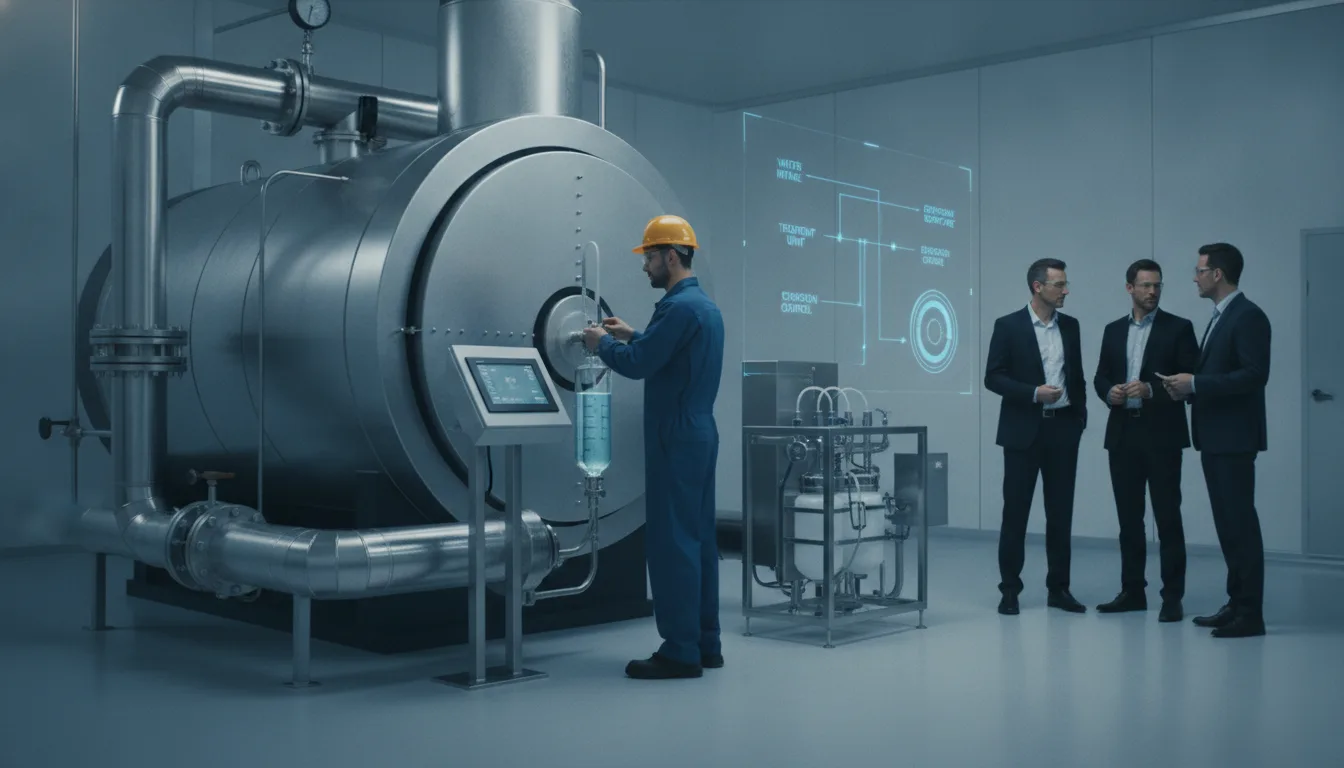
- Process flow: Makeup water → feedwater → boiler water → steam → condensate → feedwater.
- Where treatment acts: Chemicals are controlled in the boiler water to support boiler scale control, boiler corrosion control and boiler sludge conditioning.
Effective control depends on routine boiler water testing and adjustment to actual operating conditions, helping protect steam quality and boiler reliability.
Why Boiler Water Conditions Need Control
Hardness salts and other dissolved contaminants can precipitate on heat-transfer surfaces, creating insulating scale. Effective boiler scale control protects heat transfer and fuel efficiency. According to U.S. Department of Energy boiler guidance,.
Boiler water chemistry also influences metal condition throughout the system. Oxygen can drive pitting in feedwater areas, carbon dioxide can attack condensate lines, and dissolved salts or unsuitable pH can accelerate corrosion in boiler and steam-side components. Consistent boiler corrosion control helps preserve equipment condition.
- Suspended solids can settle as sludge, restrict circulation and increase blowdown demand.
- Excess dissolved solids can promote foaming, priming and carryover, reducing steam quality.
Controlling these conditions supports stable operation, lower maintenance exposure and stronger boiler reliability.
The Main Internal Treatment Objectives
A sound boiler water treatment program has five connected objectives. It must limit scale, support boiler corrosion control, condition sludge for removal, manage dissolved solids through blowdown, and maintain steam purity.
- Scale control: prevent insulating deposits on heat-transfer surfaces.
- Corrosion control: protect boiler metal from damaging reactions.
- Boiler sludge conditioning: keep precipitates removable.
- Dissolved-solids management: control concentration through blowdown.
- Steam purity: reduce carryover risks for the intended steam use.
The appropriate balance depends on boiler pressure, feedwater quality, condensate return, metallurgy, steam use and operating practices. Chemical selection should follow boiler water testing and system assessment, not catalogue-based selection.
For example, a low-pressure process boiler with substantial condensate return may need a different focus than one with higher makeup-water demand, which can introduce more dissolved solids. Water analysis must confirm both programs. Brykonchem process chemistry solutions consider actual process conditions.
Common Chemical Functions in Internal Boiler Treatment
Internal boiler water treatment uses complementary chemical functions, not a universal recipe. Selection and control depend on boiler design, feedwater quality, operating pressure and safety requirements.
| Function | Issue addressed | Variable to monitor | Incorrect-control risk |
|---|---|---|---|
| Oxygen scavenging | Dissolved-oxygen corrosion | Residual scavenger and dissolved oxygen | Corrosion or excess chemical carryover |
| pH control | Corrosive boiler water chemistry | Boiler-water pH | Metal attack or caustic conditions |
| Alkalinity control | Unstable water conditions | Alkalinity | Foaming or corrosion risk |
| Phosphate or polymer | Hardness deposits | Program residual and hardness | Scale or excess sludge |
| Dispersants | Settled suspended solids | Suspended solids and blowdown | Poor boiler sludge conditioning |
Dispersants help keep solids manageable for blowdown removal. Chemical choice and dosage require system-specific assessment to support boiler reliability.
Monitoring and Blowdown Are Part of the Treatment Program
Internal boiler water treatment is not set-and-forget. Representative sampling and regular boiler water testing show whether the selected chemistry is controlling conditions as load, feedwater quality and condensate return change.
- Test feedwater, boiler water and condensate where return quality is relevant.
- Track conductivity, pH, alkalinity, hardness, phosphate or sulfite, according to the treatment program.
Blowdown removes concentrated dissolved solids and suspended contaminants from the boiler. Its rate must control water quality without unnecessarily increasing heat, water and chemical losses.
For example, a rise in conductivity should prompt a review of blowdown practice, feedwater quality, chemical feed performance and sampling accuracy before changing treatment. Set targets using applicable boiler manufacturer guidance, site procedures and relevant standards.
How to Build an Application-Specific Internal Treatment Plan
Build an internal boiler water treatment plan from the actual system, not a standard chemical schedule. Record boiler pressure and capacity, feedwater source, pretreatment equipment, condensate return percentage, steam end use, metallurgy and current operating concerns.
- Review feedwater and boiler-water analysis results.
- Check current chemistry, dosage rates and chemical feed points.
- Examine test records, blowdown practice and signs of deposits or corrosion.
- Consider how production changes affect boiler water chemistry.
Use this information to define measurable objectives, such as stable boiler-water control, lower deposit risk, controlled blowdown and reliable steam quality. These objectives help connect boiler scale control, boiler corrosion control and boiler sludge conditioning to day-to-day operation.
A structured approach is to understand operating conditions, analyse contributing factors, recommend suitable chemistry and an application method, then implement with technical support. Brykonchem’s process chemistry solutions include boiler reliability support and application-specific recommendations based on site conditions.
Hypothetical assessment checklist: compare recent water tests with control limits, verify feed equipment operation, inspect available deposit evidence, review condensate quality and confirm that blowdown supports the intended treatment program.
When to Seek Technical Support
Routine adjustments have limits. Seek technical support when boiler water testing and operating performance show recurring or unexplained changes, including:
- Recurring scale or deposits despite normal treatment feed
- High or rising blowdown demand
- Unstable test results or unexplained chemical consumption
- Corrosion evidence, wet steam concerns, or repeated operational interruptions
For example, a recurring deposit may prompt an operator to increase chemical dosage. This can fail when feedwater hardness is breaking through, the chemical feed pump is miscalibrated, or blowdown is not controlling dissolved solids. These conditions should be checked before changing the treatment rate.
An effective internal boiler water treatment diagnosis considers water quality, temperature, concentration, contact time, mechanical conditions and existing chemistry. Review both the chemistry and its application method, rather than treating dosage as the only response. For boiler reliability concerns, Brykonchem’s process chemistry solutions, including process challenge analysis and technical process support, can help identify the underlying cause.
Frequently Asked Questions
Is internal boiler water treatment enough on its own?
No. Internal boiler water treatment controls conditions within the boiler, but reliable boiler operation also depends on suitable feedwater treatment, deaeration where applicable, condensate management, routine monitoring and controlled blowdown. An application-specific programme should consider the full water and steam cycle, not only the boiler drum.
What causes scale in an industrial boiler?
Scale in an industrial boiler commonly forms when hardness minerals, silica and other dissolved solids become concentrated as water turns to steam, then deposit on heat-transfer surfaces. The actual cause should be confirmed through feedwater and boiler-water analysis, deposit examination and a review of operating conditions.
How often should boiler water be tested?
Boiler water should be tested at a frequency based on boiler pressure and load, makeup-water quality, the treatment program, automation level and site procedures. Follow the treatment supplier's program, boiler manufacturer guidance and applicable standards, adjusting monitoring when operating conditions or water quality change.
Why is boiler blowdown important?
Boiler blowdown is important because it controls the concentration of dissolved and suspended solids in boiler water, helping limit scale, sludge and carryover risks. Too little blowdown can impair heat transfer and reliability, while excessive blowdown wastes heat, water and treatment chemicals.
Can the same boiler treatment chemistry be used in every system?
No. A boiler treatment program must be matched to the specific system, because feedwater quality, operating pressure, condensate return, metallurgy, steam use and existing scale, corrosion or sludge issues all affect chemistry selection and control targets. Brykonchem applies an application-focused process chemistry approach to help align boiler reliability treatment with actual operating conditions.
Conclusion
Effective internal boiler-water treatment depends on controlling dissolved solids, oxygen, alkalinity, scale-forming contaminants and sludge through chemistry that matches the feedwater and operating conditions. Brykonchem can assess boiler-water conditions, current chemistry and operating practices to recommend an application-specific approach supported by technical process expertise.
Need a More Reliable Boiler Water Program?
Brykonchem can assess your boiler-water conditions, current chemistry, operating practices and performance concerns, then recommend an application-specific treatment approach with technical process support.
Learn more